Wow... it's been a long time since I've written here (and I'm not going to start now!) Just enjoying a lazy Christmas Eve morning before heading to work.
I believe that the official countdown can begin... 60 more days!
Merry Christmas!
Thursday, December 23, 2010

Thursday, May 6, 2010
No Pets!
Just a quick random thought here...
When we first arrived in Iraq, they sat us down in a small room and explained the rules to us (General Order #1, which is actually many orders, but whatever) One of the rules was "No Pets". To a casual observer, this makes a lot of sense. The animals here are disease-ridden, mangy, and wild. Keeping one as a pet would be unsanitary at best, dangerous at worst.
Well, then comes reality, which is that the Soldiers, Sailors, Airmen, and Marines here are homesick and some of them miss their pets. While I don't expect that one would find many pet dogs in the CHUs (containerized housing units), there does seem to be a lot of "adoptions" going on. The most visible offense concerns a small family of geese, including a small brood of goslings.
They're cute, they take your mind off of work/war/missing home. So, although it took me by surprise how often I saw people hand feeding the little disease factories, after a few weeks, I sympathized with the offenders.
Unfortunately, those cute little goslings have reached an adolescent stage (they grow up so quickly!) and are now ugly terrors, trained to chase after anything with two legs and deep pockets.
Oh, well... the distraction was nice while it lasted.

When we first arrived in Iraq, they sat us down in a small room and explained the rules to us (General Order #1, which is actually many orders, but whatever) One of the rules was "No Pets". To a casual observer, this makes a lot of sense. The animals here are disease-ridden, mangy, and wild. Keeping one as a pet would be unsanitary at best, dangerous at worst.
Well, then comes reality, which is that the Soldiers, Sailors, Airmen, and Marines here are homesick and some of them miss their pets. While I don't expect that one would find many pet dogs in the CHUs (containerized housing units), there does seem to be a lot of "adoptions" going on. The most visible offense concerns a small family of geese, including a small brood of goslings.
They're cute, they take your mind off of work/war/missing home. So, although it took me by surprise how often I saw people hand feeding the little disease factories, after a few weeks, I sympathized with the offenders.
Unfortunately, those cute little goslings have reached an adolescent stage (they grow up so quickly!) and are now ugly terrors, trained to chase after anything with two legs and deep pockets.
Oh, well... the distraction was nice while it lasted.

Sunday, May 2, 2010
First Mass E-mail
Reporting from Camp Victory, Baghdad, Iraq
So, I sent out a mass e-mail last month and I've been meaning to post it and start writing on here a little more. Here it is (slightly edited for mass consumption):
Roughly a year has passed since my last mass e-mail and I really couldn’t have gone through more of a transition than the past year has taken me through. First, thanks again to everyone that helped support the Rural Education program in India. The fundraiser was a great success and with your help we were able to sponsor one of their schools for an entire year. I receive updates from time to time and their program continues to grow and gather interest in India and abroad.
So, I sent out a mass e-mail last month and I've been meaning to post it and start writing on here a little more. Here it is (slightly edited for mass consumption):
Roughly a year has passed since my last mass e-mail and I really couldn’t have gone through more of a transition than the past year has taken me through. First, thanks again to everyone that helped support the Rural Education program in India. The fundraiser was a great success and with your help we were able to sponsor one of their schools for an entire year. I receive updates from time to time and their program continues to grow and gather interest in India and abroad.
After graduation, I took advantage of the gap in my orders and spent nearly 6 weeks in Europe, seeing the sights and visiting friends, it was just what I needed after a stressful year of grad school... Returning to the states, I moved to Norfolk and began my training as the Assistant Navigator on the USS Theodore Roosevelt, only to find that the ship was about to start a long refueling and overhaul period. You’ll remember that I was confused as to why they wanted a helicopter pilot driving a ship – compound that with a ship that doesn’t have any water under it… (Actually, maybe THAT IS why they gave me the job!) Well, despite being handicapped by a lack of water, I managed to spend some time at sea and earn a qualification as an aircraft carrier Officer of the Deck. Shortly after returning to dry land, I was informed that I was the lucky winner of a one year vacation in Sunny Iraq! Needless to say, I was thrilled at the chance to put my life on hold for a year, but not given much of a choice, I made the best of it and started my preparations.
It’s been a long journey, but after six weeks of packing and unpacking, marching and shooting, planes and buses, swamps and deserts, I’ve arrived safely in my new home for the next year: Camp Victory, Baghdad, Iraq.
First, I just wanted to thank everyone again for all their well wishes, prayers, thoughts, and kind words as I went through this process. Knowing that I had your support made it that much easier as I was leaving everyone behind. In truth, despite some austere living conditions, the training that I’ve been going through hasn’t been bad. The most common complaint has been that there’s a lot of time spent waiting around. The Army calls it “White Space”, which is not to be confused with “Free Time”, “Down Time”, or “Personal Time”… OK, I digress.
As I was saying, the training was pretty good. We started off at Fort Jackson, South Carolina and between simulator rifle ranges (huge video games) and the real thing, I probably shot over 500 rounds on my M9 and M16, and, as a bonus, it turns out I’m a pretty good shot. Looks like all that time at summer camp as a kid paid off! Besides shooting, I also had an opportunity to drive Humvees, assault buildings, rescue wounded soldiers, and, of course, march around the base! After leaving the beautiful swamplands of South Carolina, we found ourselves in the Kuwaiti desert. Even in early March we hit triple digit temperatures a few times. Our time in Kuwait was mostly spent acclimatizing to the time and climate. We had some paperwork to do and a day of convoy training near the Iraqi boarder, but it was otherwise uneventful. It was even relaxing if you consider sleeping on a cot in a tent with 30 other guys relaxing.
This video is a funny look at the training. It was filmed a few years ago, but still hits the essence of what I was doing. (I’m not in Baghdad to look for explosives though… more on that in a minute) The official video is a little more “motivational” and not quite so funny unless you consider the irony of it all.
I arrived at Baghdad International Airport (or BIAP in Army lingo) on the 13th after having been given 6 hours notice to pack up all my stuff and get on a plane. It was only a 2 hour flight from Kuwait, but sitting in the back of a cargo plane wearing body armor makes even a short flight seem interminably long. Fortunately, since we’d arrived early, I had Sunday off to explore before starting work on Monday.
The base is fairly nice, as nice as you could expect for a the forward headquarters of an invasion force. The US Army took advantage of Hussein’s private compound and communication systems to create a functional headquarters. Because of that it seems a bit schizophrenic at times, with huge elaborate palaces next door to portable buildings and makeshift barriers. On my walk to work every morning I leave my CHU (Containerized Housing Unit, which is about as lovely as it sounds) through a serious of blast walls and walk along a dirt road until I get to one of the canals. From there I wander along the paths created for Iraqi leadership that wind along several manmade lakes and between a few more palaces. My office happens to be about as far away as possible, in the house that my friends and I suspect Hussein would put his “friends” that he was considering for summary execution.
As far as my job goes I would have to classify myself as a “Warrior Accountant”. Warrior because I’m always wearing a gun and accountant because, well, that’s what I do. I work for General Odierno’s Comptroller and try to keep the Army from spending too much money. I’m tasked with “preserving the treasure of our nation” and it’s quite a challenge. Those Army guys love to buy stuff. Last week I processed around 250 million dollars in requests, no big deal… Of course it really couldn’t get too much more like Office Space than this, I don’t think I would survive the scrutiny of the Bob’s (“So you take the requests from the customer?”, “No, my secretary does that.”)
At least I do feel fully employed, which is more than some of my friends are saying as they sit around waiting for work to come. One of my challenges is that I don’t have much personal time, I work 7 days a week, 10-11 hours a day, with 2 half days. It does make the time go by fairly quickly though, I can’t believe that I’ve been here for over 2 weeks already! The unexpected highlight of my time here is the frequent 5Ks which are fun to run and have the added bonus of getting me out of work (culture of fitness and all that...)
I really don’t need much of anything here. The Post Exchange is relatively well stocked. Being at the headquarters for the Army does have its benefits. I’d love to receive your mail though, and I promise that if you write, I’ll write back (I’ll even try to get it out before I leave Iraq!) If you really are interested in providing aid and comfort to me and my fellow deployed Sailors, Soldiers, Airmen, and Marines, please consider donating to either the USO or the Navy-Marine Corps Relief Society. They’re both great organizations that help military members in times of hardship and distress. They are both full of hardworking and helpful volunteers that make great efforts to make the lives easier for everyone serving.
I love you all and miss you. For all my family about to celebrate Easter, I wish that I could be there with you and look forward to rejoining next year! I’m sorry that I’ll miss Sabrina and McKenna and Mille and Zach’s graduations (they must be from Junior High, right? I’m not that old…)
Oh and as far as the subject line goes, it just rained for the last two days, turning all the fine sand and dust into mud. It sticks to everything and apparently takes several days to dry up. Surprises every day!
You’re all in my thoughts and I’m looking forward to my return home to see everyone again (343 days left!)
Stephen
Saturday, February 13, 2010
Off to Army Camp
Reporting from Camp McCrady, Fort Jackson, South Carolina
I made it. I am now firmly ensconced in the US Army, or rather the South Carolina National Guard. After a week of pokes and prods, waiting in long lines, and sitting quietly, I can now expect more of the same!
For those of you who aren't familiar with South Carolina geography, I'm sleeping under the green arrow below:
 Other than an infuriatingly slow bus trip, the day has been uneventful. I was impressed first thing this morning by a group of well-wishers as we boarded the buses. Apparently they're out there every week giving the sailors heading overseas a smile and a pat on the back. We each received a small care package loaded with delicious junk food, home baked cookies, and a note from a local 4th grade class. The cynic in me found it slightly comical, but I suppressed that impression and tried to appreciate the good natured outpouring of support as just that.
There were some heart-wrenching moments as young mothers and fathers said goodbye to their children, including a new-born infant, and families parted ways. This is a clear reminder of one of the greatest sacrifice of the men and women being sent over seas: lost time with their families. Whether going to the relative safe locations of Kuwait or Qatar, or facing danger in Anbar or Helmand, all these soldiers, sailors, airmen, and marines will miss out on countless irreplaceable moments in the lives of the families and loved ones. I know that, for me at least, this is the most difficult aspect of the deployment.
Now we're just back in sit-and-wait mode, the next event doesn't happen until tomorrow afternoon. The weeks are heavily scheduled, but we should have some time to relax and head into Columbia next weekend, which I hear is the New YorkCity of the South...
I made it. I am now firmly ensconced in the US Army, or rather the South Carolina National Guard. After a week of pokes and prods, waiting in long lines, and sitting quietly, I can now expect more of the same!
For those of you who aren't familiar with South Carolina geography, I'm sleeping under the green arrow below:
 Other than an infuriatingly slow bus trip, the day has been uneventful. I was impressed first thing this morning by a group of well-wishers as we boarded the buses. Apparently they're out there every week giving the sailors heading overseas a smile and a pat on the back. We each received a small care package loaded with delicious junk food, home baked cookies, and a note from a local 4th grade class. The cynic in me found it slightly comical, but I suppressed that impression and tried to appreciate the good natured outpouring of support as just that.
There were some heart-wrenching moments as young mothers and fathers said goodbye to their children, including a new-born infant, and families parted ways. This is a clear reminder of one of the greatest sacrifice of the men and women being sent over seas: lost time with their families. Whether going to the relative safe locations of Kuwait or Qatar, or facing danger in Anbar or Helmand, all these soldiers, sailors, airmen, and marines will miss out on countless irreplaceable moments in the lives of the families and loved ones. I know that, for me at least, this is the most difficult aspect of the deployment.
Now we're just back in sit-and-wait mode, the next event doesn't happen until tomorrow afternoon. The weeks are heavily scheduled, but we should have some time to relax and head into Columbia next weekend, which I hear is the New YorkCity of the South...
Thursday, March 12, 2009
Op-Ed
Reporting from Cambridge
Just wanted to note that an opinion piece I wrote in the Harvard Citizen was published this week. The text is below in case the link changes.
“Che du… Cha de wu… cha du vu…” The children laughed heartily as I blundered through the phrase that they were trying to teach me. I’m confident that they considered me a bumbling idiot, not even able to parrot such a simple phrase.
Just wanted to note that an opinion piece I wrote in the Harvard Citizen was published this week. The text is below in case the link changes.
“Che du… Cha de wu… cha du vu…” The children laughed heartily as I blundered through the phrase that they were trying to teach me. I’m confident that they considered me a bumbling idiot, not even able to parrot such a simple phrase.
Just seventy miles away from the economic miracle of Bangalore, India, with its gleaming IT campuses reminiscent of Silicon Valley, lies an obscure rural valley experiencing a miracle of its own: the Rishi Valley Education Center. While Rishi Valley may not have the media appeal of companies like Infosys and other upstart IT companies that are changing the way the world does business, it is having a profound and fundamental impact on the Indian educational system.
The mission of the Center is simple: provide a quality, village-based elementary education for rural children in multi-grade, one-room schoolhouses. However, as is often the case, significant cultural and economic barriers complicate achieving this simple goal.
In a region where most live on subsistence farming and every family member must contribute, education frequently becomes a low priority for parents and children alike. The realities of survival in such a poor area make it difficult to convince the community to embrace education. Additionally, students often live miles from the nearest government school with no option other than to walk miles each day to attend school.
Furthermore, the educators at Rishi Valley found that the families frequently required their children to be out of school for extended periods that did not conform to the standard educational schedule. These students, upon returning to the classroom, found themselves lagging behind their peers and consequently lost motivation to continue.
In response to these problems, the husband and wife team of Y.A. and Rama Rao created an elegant solution that they call “School in a Box.” The curriculum is modular, with simple graphics of plants and animals, color-coded by subject area, to depict the progress and level of the students. These graphical “achievement ladders” are simple enough for both children and illiterate adults to understand, leading to an increased level of parent participation. The self-contained lessons provide the teachers of the one-room schoolhouses with enough flexibility to support up to 25 children spread across five grade levels.
The Raos believe that in a society with such strong communal bonds, it is vitally important for the entire community be involved in the schools. To encourage community participation, they developed a program of math and science fairs, organized by the schools, but run by the students themselves. We, the HKS India Trekkers, were lucky enough to attend one such “Math Mela” over the winter break, and we were amazed by the turnout. It seemed as though the entire village attended. Eager students wearing sashes saying “Can I help you?” quickly split us up and took us to the various stations where we had to guess the metric measurements of sticks and weights of different foods. Each station had a student that graded our attempts to use Tangrams, measure our height, or use an abacus-like counting device. Despite some communication problems, we performed fairly well on our student-issued report cards, although there may have been some grade inflation.
In less than two decades, the program has made amazing progress, expanding from a handful of village-based schools to 15 across the Rishi Valley. The Center has also worked with regional governments in India and other national governments to bring the “School in a Box” process to one-room schoolhouses in other parts of the world.
Thus far, the results have been astounding. Graduates of the program are well received in the government middle schools and high schools, outperforming their peers in traditional elementary school programs. In this impoverished area where as many as 25 percent of school-aged children are considered child laborers by UNICEF standards and schools consistently underperform their urban equivalents, this success is encouraging. If India is to maintain the economic momentum it has achieved through enterprises like Infosys, the level of education provided to its youth must continue to improve. Innovative programs such as this offer great hope.
The Rishi Valley Rural Education program operates on an annual budget of less than $50,000, but struggles to raise even that meager sum. Luckily, even from Cambridge’s ivy-covered walls, we can help.
Just $2,500 runs one village school for an entire year. Please help the students of the HKS India Trek reach this goal and attend the fundraiser at Tommy Doyle’s on April 2nd at 8 pm. The minimum suggested donation will be $10 at the door, but please consider giving $15 - enough to fund a student for an entire month. We look forward to seeing you there - the students of Rishi Valley need your help!
Oh, and the phrase that I finally managed to repeat successfully? “Cha-du-vu, kor-e-ka.” It means, “I want to learn.”
Monday, January 19, 2009
Reflections
Reporting from Washington, DC.
I'm home! (almost)
I just wanted to wrap up my trip with a couple of thoughts.
Travel Agent: If anyone is looking for a great travel agency in India, I can't recommend SITA highly enough. They were great: didn't miss a transfer , were flexible for a group looking for a non-tourist agenda, and set up a great group of travel guides. While I don't think its necessary to have a full service travel agent while in India, it certainly helps.
Denial: In our meetings with Indian government officials, I was frequently impressed with how well they understood the gravity of their situation and the incredible hurdles they are facing to bring India from the "developing" to the "developed" column. In a country with nearly four times the population of the US and less than one-tenth the income, they have challenges beyond compare. That said, there is a large segment of the population that does not recognize that India is not there yet and those are the people that are clamoring at the door of world prestige, but forgetting of all the indigent and helpless people of India that they are cruelly standing on.
I was dismayed to read an op-ed in India Times last week that was complaining about India's portrayal in Slumdog Millionaire. It said that it portrayed India in a negative light, with all the poverty and homelessness. I haven't seen the movie yet, but I understand that this movie really was one of the triumph of human spirit and that the Indian people were featured highly in it. Unfortunately, the sentiments expressed by the author, a prominent Bollywood director, seem to me all too typical of the upper classes. They have found it relatively convenient to forget that India has a population nearly the size of the US that lives on less than $1.25 per day (the World Bank definition of extreme poverty.)
This may be a stinging indictment of India's wealthy and probably unfair to many of them that care deeply for the economic problems of their fellow countrymen, but even after a week it seemed clear to me that this denial was pervasive in the press.
Leakage: One of our first meetings in the country was with 1298 Amulance, whose founder discussed some of the issues that they were having with "leakage", a euphamism for employee theft and government graft. They were solving the problem with technology, increasing monitoring of ambulance movements to prevent moonlighting with company equipment. At first I didn't think too much of this, but by the end of the trip I realized that India has an epidemic of leakage and 1298 has an uphill battle. The corruption ranged from the billion dollar Satyam scandal to fifty rupee taxi ripoffs. While it is clear that these issues have direct negative impacts on the economy they also have further ranging implications: they create intangible barriers to commerce. Whether it's multinationals no longer wishing to do business with large Indian companies or tourists (like us) that tired of getting slowly and constantly ripped off, India is losing business to this culture of corruption and must take more concerted action to solve the problem.
People: I said it a few times, but wanted to reiterate that the Indian people are amazing. Living in a place with such hardships and remaining optimistic is not an insignificant accomplishment. They are generally friendly, even in a place like Mumbai where personal space is at a premium and it would be very easy to become agitated and rude. The tragedy in Mumbai also provides another aspect of the Indian's generosity and kindness of spirit as they all pulled together to get through the past few difficult months. They are the country's greatest resource.
I'm home! (almost)
I just wanted to wrap up my trip with a couple of thoughts.
Travel Agent: If anyone is looking for a great travel agency in India, I can't recommend SITA highly enough. They were great: didn't miss a transfer , were flexible for a group looking for a non-tourist agenda, and set up a great group of travel guides. While I don't think its necessary to have a full service travel agent while in India, it certainly helps.
Denial: In our meetings with Indian government officials, I was frequently impressed with how well they understood the gravity of their situation and the incredible hurdles they are facing to bring India from the "developing" to the "developed" column. In a country with nearly four times the population of the US and less than one-tenth the income, they have challenges beyond compare. That said, there is a large segment of the population that does not recognize that India is not there yet and those are the people that are clamoring at the door of world prestige, but forgetting of all the indigent and helpless people of India that they are cruelly standing on.
I was dismayed to read an op-ed in India Times last week that was complaining about India's portrayal in Slumdog Millionaire. It said that it portrayed India in a negative light, with all the poverty and homelessness. I haven't seen the movie yet, but I understand that this movie really was one of the triumph of human spirit and that the Indian people were featured highly in it. Unfortunately, the sentiments expressed by the author, a prominent Bollywood director, seem to me all too typical of the upper classes. They have found it relatively convenient to forget that India has a population nearly the size of the US that lives on less than $1.25 per day (the World Bank definition of extreme poverty.)
This may be a stinging indictment of India's wealthy and probably unfair to many of them that care deeply for the economic problems of their fellow countrymen, but even after a week it seemed clear to me that this denial was pervasive in the press.
Leakage: One of our first meetings in the country was with 1298 Amulance, whose founder discussed some of the issues that they were having with "leakage", a euphamism for employee theft and government graft. They were solving the problem with technology, increasing monitoring of ambulance movements to prevent moonlighting with company equipment. At first I didn't think too much of this, but by the end of the trip I realized that India has an epidemic of leakage and 1298 has an uphill battle. The corruption ranged from the billion dollar Satyam scandal to fifty rupee taxi ripoffs. While it is clear that these issues have direct negative impacts on the economy they also have further ranging implications: they create intangible barriers to commerce. Whether it's multinationals no longer wishing to do business with large Indian companies or tourists (like us) that tired of getting slowly and constantly ripped off, India is losing business to this culture of corruption and must take more concerted action to solve the problem.
People: I said it a few times, but wanted to reiterate that the Indian people are amazing. Living in a place with such hardships and remaining optimistic is not an insignificant accomplishment. They are generally friendly, even in a place like Mumbai where personal space is at a premium and it would be very easy to become agitated and rude. The tragedy in Mumbai also provides another aspect of the Indian's generosity and kindness of spirit as they all pulled together to get through the past few difficult months. They are the country's greatest resource.
Lessons on the last day
Reporting from Bombay Airport
Lesson 1 - If you’ve hired a full service travel agency, use it! We came to a consensus that sitting around in the airport for fourteen hours was not the best of plans, so we made arrangements to stay in a hotel until it was time to check-in. When we arrived, the SITA representative meeting us at the airport was mildly concerned that we’d set ourselves up for failure and, in fact, the hotel didn’t have the van space to take us all. Fortunately, SITA already had a bus for us! In the end, everything worked out, just something to remember for the future.
Lesson 2 – You can’t buy a plane ticket at the airport after 26/11 (Mumbai Terrorist attacks.) I made the mistake of showing up to the airport without a copy of my itinerary, which is even required to get through the front door. I made a lame plea to be allowed in and the guy refused, but it turns out that they had a copy of the passenger manifests anyway. They eventually let me in, but only after some grief.
Lesson 3 – Dominos delivers, even in Mumbai.
Lesson 1 - If you’ve hired a full service travel agency, use it! We came to a consensus that sitting around in the airport for fourteen hours was not the best of plans, so we made arrangements to stay in a hotel until it was time to check-in. When we arrived, the SITA representative meeting us at the airport was mildly concerned that we’d set ourselves up for failure and, in fact, the hotel didn’t have the van space to take us all. Fortunately, SITA already had a bus for us! In the end, everything worked out, just something to remember for the future.
Lesson 2 – You can’t buy a plane ticket at the airport after 26/11 (Mumbai Terrorist attacks.) I made the mistake of showing up to the airport without a copy of my itinerary, which is even required to get through the front door. I made a lame plea to be allowed in and the guy refused, but it turns out that they had a copy of the passenger manifests anyway. They eventually let me in, but only after some grief.
Lesson 3 – Dominos delivers, even in Mumbai.
Sunday, January 18, 2009
Buy, Buy, No Buy, Goodbye
Reporting from Jaipur
Our last full day in India. We didn’t have much of an itinerary, so today was meant to be pretty relaxing, mostly just finish up shopping. Waking up to say goodbye to Anjali, our trip organizer extraordinaire, we splintered off into small tuk-tuk sized groups to find some more Rajastani treasures.
We found Gopal Singh.
Gopal was a friendly, older, tuk-tuk driver that offered to take us around the city for a princely sum of 50rs per person for 1 hour. We managed to talk him down to 150 for 2 hours (roughly 3 dollars). He then took us to all his favorite (probably commissioned) places. It was pretty enjoyable for the most part and while I wouldn’t recommend cramming five Americans (well, one of us was German) into a tuk-tuk, we made it work. We spent a good amount of time at a fabric place that had markedly improved quality of products compared to yesterday’s market. While there Gopal explained his shopping philosophy “buy, buy, no buy, good-bye.” Sounded good to us!
His next recommendations were busts… a junky restaurant and an overpriced jewelry store. We declared victory and returned to the hotel. When Gopal dropped us off, he seemed a bit miffed that we only paid him double the negotiated fare, despite the pretty significant commission he likely earned from the fabric store and restaurant. Oh well.
Not interested in dealing with crazy cab drivers, we decided to have our final dinner at the hotel’s rooftop. It was a great dinner: we reflected on the trip’s highlights and applauded ourselves for being so great (like a small, slightly less glamorous version of the Oscars.) I’ll talk about that more later.
Tomorrow – the long trek back to the States!


Our last full day in India. We didn’t have much of an itinerary, so today was meant to be pretty relaxing, mostly just finish up shopping. Waking up to say goodbye to Anjali, our trip organizer extraordinaire, we splintered off into small tuk-tuk sized groups to find some more Rajastani treasures.
We found Gopal Singh.
Gopal was a friendly, older, tuk-tuk driver that offered to take us around the city for a princely sum of 50rs per person for 1 hour. We managed to talk him down to 150 for 2 hours (roughly 3 dollars). He then took us to all his favorite (probably commissioned) places. It was pretty enjoyable for the most part and while I wouldn’t recommend cramming five Americans (well, one of us was German) into a tuk-tuk, we made it work. We spent a good amount of time at a fabric place that had markedly improved quality of products compared to yesterday’s market. While there Gopal explained his shopping philosophy “buy, buy, no buy, good-bye.” Sounded good to us!
His next recommendations were busts… a junky restaurant and an overpriced jewelry store. We declared victory and returned to the hotel. When Gopal dropped us off, he seemed a bit miffed that we only paid him double the negotiated fare, despite the pretty significant commission he likely earned from the fabric store and restaurant. Oh well.
Not interested in dealing with crazy cab drivers, we decided to have our final dinner at the hotel’s rooftop. It was a great dinner: we reflected on the trip’s highlights and applauded ourselves for being so great (like a small, slightly less glamorous version of the Oscars.) I’ll talk about that more later.
Tomorrow – the long trek back to the States!

Inspecting the merchandise

Sareena and Sam at dinner
Tourists on Elephants
Reporting from Jaipur
We got to sleep in ‘till 8 this morning! Yes, I do like my sleep. This would be a full day of tours, nothing to redeem the day academically or intellectually. I’m fine with that though.
First up, elephants.
We visited the Amber Fort, an incredible medieval palace not far from Jaipur city on a hill. The traditional way for tourists to get up the hill is on the back of elephants. Of course, what other way would one climb a hill while in India? We fit in well with the other tourists, some of whom were sporting the turbans they’d purchased from the touts in the line. I suppose there was an alternate route, but why would we pass on the elephants? Other than the last minute fleecing by the elephant “driver”, it was everything we wanted (needed?) it to be.
The fort was a spectacular setting with several palaces and a warren-like harem in the back. We spent most of the time getting lost and finding secret rooms. Apparently, the way down from the fort is by jeep…
Next, we visited the City Palace, which was built by one of the maharajas from the Amber fort. Not a whole lot there other than the largest (as registered in the Guinness Book) silver urn.
We ditched the guide after he wanted to take us to the government jewelry store (for a sizeable commission.) All that was left was shop and haggle until we were exhausted, which didn’t take too long. The market we were shopping had a ton of shops and touts, but was light on quality goods. A perfect place to hone our bargaining skills. After about two hours of “that’s not possible my friend”, “for my first customer, a special price”, near walk outs, and treasures acquired, we took our bags home.
That evening we went to dinner at rooftop Mediterranean place that had a huge square table capable of accommodating all twelve of us. The food was good and the staff friendly, but the best part was the beer served in teapots! There’s nothing quite like drinking your beer out of a coffee mug after pouring it from a teapot…
 Excited to be on the prettiest elephant in Jaipur
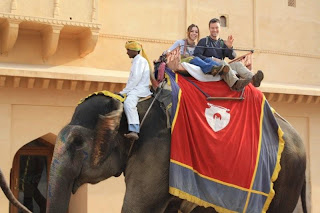 Excited to be alive


We got to sleep in ‘till 8 this morning! Yes, I do like my sleep. This would be a full day of tours, nothing to redeem the day academically or intellectually. I’m fine with that though.
First up, elephants.
We visited the Amber Fort, an incredible medieval palace not far from Jaipur city on a hill. The traditional way for tourists to get up the hill is on the back of elephants. Of course, what other way would one climb a hill while in India? We fit in well with the other tourists, some of whom were sporting the turbans they’d purchased from the touts in the line. I suppose there was an alternate route, but why would we pass on the elephants? Other than the last minute fleecing by the elephant “driver”, it was everything we wanted (needed?) it to be.
The fort was a spectacular setting with several palaces and a warren-like harem in the back. We spent most of the time getting lost and finding secret rooms. Apparently, the way down from the fort is by jeep…
Next, we visited the City Palace, which was built by one of the maharajas from the Amber fort. Not a whole lot there other than the largest (as registered in the Guinness Book) silver urn.
We ditched the guide after he wanted to take us to the government jewelry store (for a sizeable commission.) All that was left was shop and haggle until we were exhausted, which didn’t take too long. The market we were shopping had a ton of shops and touts, but was light on quality goods. A perfect place to hone our bargaining skills. After about two hours of “that’s not possible my friend”, “for my first customer, a special price”, near walk outs, and treasures acquired, we took our bags home.
That evening we went to dinner at rooftop Mediterranean place that had a huge square table capable of accommodating all twelve of us. The food was good and the staff friendly, but the best part was the beer served in teapots! There’s nothing quite like drinking your beer out of a coffee mug after pouring it from a teapot…
 Excited to be on the prettiest elephant in Jaipur
 Excited to be alive
Girls in the Harem windows...

I found Waldo! No, wait... that's me...
Saturday, January 17, 2009
Cultural Show
Reporting from Jaipur
Another early morning (sorry for the broken record on this…), I managed to get my act together and pour myself onto the bus. The trip from Delhi to Jaipur lasted about six hours. When we finally arrived, I promptly crashed in my hotel room.
I finally felt like a real person again around dinner, which was a good thing because the agenda for the evening was not to be missed. The tour guide set us up at a garden restaurant with a dance show! It was amazing slash terrible. I hadn’t attended the last cultural event so I was excited to see what the Rajastanis had in store for us. There were pots, knives, dancing horses, and crazy Norwegians (one of whom decided that he should share his culture with the crowd.) What more could one ask for?
 Dancing, Trumpeting, Fire... What more could you ask for?
 We argued whether that was a horse or a donkey... I also have a picture of one of my friends wearing it and dancing on stage, but I'm going to spare him the embarrassment of posting it (I'm not above bribery here.)
Another early morning (sorry for the broken record on this…), I managed to get my act together and pour myself onto the bus. The trip from Delhi to Jaipur lasted about six hours. When we finally arrived, I promptly crashed in my hotel room.
I finally felt like a real person again around dinner, which was a good thing because the agenda for the evening was not to be missed. The tour guide set us up at a garden restaurant with a dance show! It was amazing slash terrible. I hadn’t attended the last cultural event so I was excited to see what the Rajastanis had in store for us. There were pots, knives, dancing horses, and crazy Norwegians (one of whom decided that he should share his culture with the crowd.) What more could one ask for?
 Dancing, Trumpeting, Fire... What more could you ask for?
 We argued whether that was a horse or a donkey... I also have a picture of one of my friends wearing it and dancing on stage, but I'm going to spare him the embarrassment of posting it (I'm not above bribery here.)
Friday, January 16, 2009
Sick
Reporting from Delhi
This posting will be much much shorter than yesterday's...
I was very sick. All day. I didn't leave the room until dinner and then didn't stay out long. I missed a couple of meetings.
Lot's of fun.
This posting will be much much shorter than yesterday's...
I was very sick. All day. I didn't leave the room until dinner and then didn't stay out long. I missed a couple of meetings.
Lot's of fun.
Meetings with Big Wigs
Reporting from Delhi
I'm embarrassed to admit that I missed a bit of the Delhi experience today while working on my final. I spent the morning holed up in my room and then returned afterward to finish it. The upside is that I did get it done in time and that it was pretty good (at least I think so.) All the worlds problems solved in 20 pages, not bad!
That said, the day was amazing even without dumpster diving through the markets. Our first meeting was with no one less than the Indian Minister of Defense Shri (Mr.) A.K. Antony. En route to India's equivalent of the Pentagon, Alicia (another Mid-Career who for the British MOD) and I brought our fellow travelers up to speed on Indian Defense issues. Once there we had a remarkably easy time getting into the meeting, without even having to show ID. We simply wrote down some information and a guide took us to the conference room. No searching, no detectors... Even active duty military has to show 2 forms of ID to get into the Pentagon...
The meeting went well, if a bit tense a times. The Minister didn't give a presentation, but preferred that the conversation be "informal". Of course, most of the questions were polite, if mildly probing. A question of corruption seemed to make the minister slightly uncomfortable, but he addressed it with the cool of a professional politician, saying that it exists, but is not as prevalent as some might think. In a free state the bad is always exaggerated by the press.
On defense issues, we discussed the Pakistan issue a bit and the minister maintained the relatively moderate position that he portrays in the press. He is clearly a critic of the US's role in supporting what he sees as a failing regime, but was hopeful for change with the next administration. He also repeated India's pledge not to be a nuclear aggressor, but didn't get into recent developments in their Nuclear Triad or seeking First Strike capabilities.
For the most part, the conversation focused on India's role in the global security environment. For this, the minister gave an answer that disappointed me personally, but is typical of a country that led the Non-Aligned Movement during the cold war and continues to participate to the detriment of global cooperation: India is not interested in global issues beyond it's own "neighborhood". I'm not going to opine on this here, but if you ever want to get me riled up, please ask me to explain why this is one of the weakest excuses for foreign policy that a supposed up and coming nation can cling to.
(pause, calm down)
Our next meeting was with Mr. Naresh Dayal, the Secretary of the Ministry of Health & Family Welfare. Essentially he holds a position similar to the Undersecretary of the HHS in the US. We had a great conversation with him and his deputies regarding improvements in rural healthcare over the past few years, especially neonatal and infants. India is still behind in meeting the Millennium Development Goals set out by UN, but is making progress. In a few of the states it has exceeded infant and maternal mortality rates, others are lagging behind drastically. They are optimistic, but a number of us were concerned that the recent successes were buoyed by the economic upturn and may not be sustainable as the market goes south. (See the interesting article I mentioned when I first arrived in India.) We had a lot of questions for the Secretary and very little time, so we left unsatiated....
Last meeting was with another Cabinet Minister (hmm... to ministers in one day, whatever...) this time from Commerce. Shri Kamal Nath was one of the primary players in the Doha round of the WTO and its subsequent failure. Naturally, that's what we talked about! He maintained that his primary reason for bringing the negotiations to a standstill was to defend the subsistence farmers of India who do not have a social safety net and cannot survive in a market flooded by subsidized American goods.
Now, I agree that the American trade delegation did not have the best stance on this (read: they were overly self-servicing and protectionist and generally made the same diplomatic mistakes that the Bush administration has been infamous for over the past 8 years.) That said, it is unfair for India to diminish its role in maintaining a distortive global trade regime. As India grows as an economic superpower it will have to make domestic concessions (as will the US), which will ultimately improve every one's quality of life.
I apologize for my going on forever here, but it's difficult to summarize in a few paragraphs meeting with people with such heavy responsibilities. Remember that they have to take care of a population nearly 4 times that of the US with an economy less than one tenth the size and a tax revenue that doesn't even compare. I don't envy their jobs and hope that they continue to make that positive improvements in their people's lives that we've seen over the past decade.
 Group with the Minister of Defense. We were joined by another group from HKS that was visiting Delhi.
 Meeting with the Minister of Commerce
I'm embarrassed to admit that I missed a bit of the Delhi experience today while working on my final. I spent the morning holed up in my room and then returned afterward to finish it. The upside is that I did get it done in time and that it was pretty good (at least I think so.) All the worlds problems solved in 20 pages, not bad!
That said, the day was amazing even without dumpster diving through the markets. Our first meeting was with no one less than the Indian Minister of Defense Shri (Mr.) A.K. Antony. En route to India's equivalent of the Pentagon, Alicia (another Mid-Career who for the British MOD) and I brought our fellow travelers up to speed on Indian Defense issues. Once there we had a remarkably easy time getting into the meeting, without even having to show ID. We simply wrote down some information and a guide took us to the conference room. No searching, no detectors... Even active duty military has to show 2 forms of ID to get into the Pentagon...
The meeting went well, if a bit tense a times. The Minister didn't give a presentation, but preferred that the conversation be "informal". Of course, most of the questions were polite, if mildly probing. A question of corruption seemed to make the minister slightly uncomfortable, but he addressed it with the cool of a professional politician, saying that it exists, but is not as prevalent as some might think. In a free state the bad is always exaggerated by the press.
On defense issues, we discussed the Pakistan issue a bit and the minister maintained the relatively moderate position that he portrays in the press. He is clearly a critic of the US's role in supporting what he sees as a failing regime, but was hopeful for change with the next administration. He also repeated India's pledge not to be a nuclear aggressor, but didn't get into recent developments in their Nuclear Triad or seeking First Strike capabilities.
For the most part, the conversation focused on India's role in the global security environment. For this, the minister gave an answer that disappointed me personally, but is typical of a country that led the Non-Aligned Movement during the cold war and continues to participate to the detriment of global cooperation: India is not interested in global issues beyond it's own "neighborhood". I'm not going to opine on this here, but if you ever want to get me riled up, please ask me to explain why this is one of the weakest excuses for foreign policy that a supposed up and coming nation can cling to.
(pause, calm down)
Our next meeting was with Mr. Naresh Dayal, the Secretary of the Ministry of Health & Family Welfare. Essentially he holds a position similar to the Undersecretary of the HHS in the US. We had a great conversation with him and his deputies regarding improvements in rural healthcare over the past few years, especially neonatal and infants. India is still behind in meeting the Millennium Development Goals set out by UN, but is making progress. In a few of the states it has exceeded infant and maternal mortality rates, others are lagging behind drastically. They are optimistic, but a number of us were concerned that the recent successes were buoyed by the economic upturn and may not be sustainable as the market goes south. (See the interesting article I mentioned when I first arrived in India.) We had a lot of questions for the Secretary and very little time, so we left unsatiated....
Last meeting was with another Cabinet Minister (hmm... to ministers in one day, whatever...) this time from Commerce. Shri Kamal Nath was one of the primary players in the Doha round of the WTO and its subsequent failure. Naturally, that's what we talked about! He maintained that his primary reason for bringing the negotiations to a standstill was to defend the subsistence farmers of India who do not have a social safety net and cannot survive in a market flooded by subsidized American goods.
Now, I agree that the American trade delegation did not have the best stance on this (read: they were overly self-servicing and protectionist and generally made the same diplomatic mistakes that the Bush administration has been infamous for over the past 8 years.) That said, it is unfair for India to diminish its role in maintaining a distortive global trade regime. As India grows as an economic superpower it will have to make domestic concessions (as will the US), which will ultimately improve every one's quality of life.
I apologize for my going on forever here, but it's difficult to summarize in a few paragraphs meeting with people with such heavy responsibilities. Remember that they have to take care of a population nearly 4 times that of the US with an economy less than one tenth the size and a tax revenue that doesn't even compare. I don't envy their jobs and hope that they continue to make that positive improvements in their people's lives that we've seen over the past decade.
 Group with the Minister of Defense. We were joined by another group from HKS that was visiting Delhi.
 Meeting with the Minister of Commerce
Wednesday, January 14, 2009
Indian Nationalism
Reporting from Delhi
Our return to Delhi this morning was uneventful and most of us slept through a significant portion of it (at least I did.)
Another touristy agenda this afternoon. We started out with a rickshaw ride through a market in Old Delhi. Being pulled through the streets by a person may not be the most ridiculous thing we could have done, but it’s up there. There was a minor revolt by a few members of the group that just wanted to walk. Their pragmatism ultimately paid off when we got stuck in a traffic jam and the walking traffic was making better progress. At which point we abandoned our rides and started to walk. Our guide seemed a bit confused at the whole ordeal: why wouldn’t a bunch of tourists want to make a spectacle of themselves? Well, at least I got some fun pictures. (I didn’t get a picture of a cow walking up and peeing on one of the rickshaws, it was priceless, but I was too slow.
Our ride/walk took us to the largest mosque in India. It is a beautiful structure, with a wide courtyard and fountain. Again, some great picture taking opportunities (200rs for a picture-taking permit.) I always find it interesting when we go through “security” at a place like that. There is generally metal detectors, there is generally a guard, but the two don’t necessarily seem to be closely associated. Rather, we walk through the metal detector, it beeps, the guard glances at us from his chair several yards away, we smile, he looks away, we continue: plot averted.
We made two more stops before returning to the hotel: the memorial to Mahatma Ghandi at the site of his cremation and Hanuman’s tomb. Both were excellent although it was surprising how few people were at the Ghandi memorial given that it was a beautiful park, free, and a Sunday.
After getting dressed up at the hotel, we pulled ourselves together for one more event, a Kennedy School alumni meeting. We arrived expecting a cocktail hour and some easy chatting, but were met with a serious lineup of speakers. (I've misplaced my notes, so no names...) Our host was a 1991 grad and introduced 2 national security experts. The conversations were very interesting (and not for attribution), but in general they painted a bleak picture for South Asian regional stability. The first speaker was a fierce Indian Nationalist, which may have its time and place, but when two countries are on the precipice of war probably not the best rhetoric. The second speaker was more measured, outlining weaknesses in the current infrastructure and planned improvements.
I sincerely hope, for the safety of all concerned, that cooler heads prevail.


Our return to Delhi this morning was uneventful and most of us slept through a significant portion of it (at least I did.)
Another touristy agenda this afternoon. We started out with a rickshaw ride through a market in Old Delhi. Being pulled through the streets by a person may not be the most ridiculous thing we could have done, but it’s up there. There was a minor revolt by a few members of the group that just wanted to walk. Their pragmatism ultimately paid off when we got stuck in a traffic jam and the walking traffic was making better progress. At which point we abandoned our rides and started to walk. Our guide seemed a bit confused at the whole ordeal: why wouldn’t a bunch of tourists want to make a spectacle of themselves? Well, at least I got some fun pictures. (I didn’t get a picture of a cow walking up and peeing on one of the rickshaws, it was priceless, but I was too slow.
Our ride/walk took us to the largest mosque in India. It is a beautiful structure, with a wide courtyard and fountain. Again, some great picture taking opportunities (200rs for a picture-taking permit.) I always find it interesting when we go through “security” at a place like that. There is generally metal detectors, there is generally a guard, but the two don’t necessarily seem to be closely associated. Rather, we walk through the metal detector, it beeps, the guard glances at us from his chair several yards away, we smile, he looks away, we continue: plot averted.
We made two more stops before returning to the hotel: the memorial to Mahatma Ghandi at the site of his cremation and Hanuman’s tomb. Both were excellent although it was surprising how few people were at the Ghandi memorial given that it was a beautiful park, free, and a Sunday.
After getting dressed up at the hotel, we pulled ourselves together for one more event, a Kennedy School alumni meeting. We arrived expecting a cocktail hour and some easy chatting, but were met with a serious lineup of speakers. (I've misplaced my notes, so no names...) Our host was a 1991 grad and introduced 2 national security experts. The conversations were very interesting (and not for attribution), but in general they painted a bleak picture for South Asian regional stability. The first speaker was a fierce Indian Nationalist, which may have its time and place, but when two countries are on the precipice of war probably not the best rhetoric. The second speaker was more measured, outlining weaknesses in the current infrastructure and planned improvements.
I sincerely hope, for the safety of all concerned, that cooler heads prevail.

In front of Hanuman's Tomb

Our bus... in case there was a doubt in anyone's mind
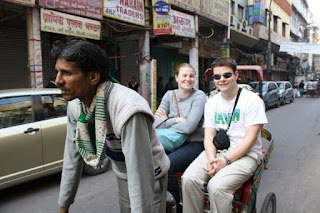

Rickshaw fun!
Another wonder of the world
OK, back to blogging…
Reporting from Agra
Another early morning today as we headed out on our five-hour bus ride to the ancient Mogul capital of Agra. Fortunately, we decided to stay the night there, instead of making it a day trip. Regardless, we’ve been racking up our bus time… The bus ride gave us another opportunity to shop at an opportunistic tourist shop along the highway, so that’s good.
A note about driving in India. First, there are no freeways and the traffic along the highways generally crawls along at about 70kph. You do get to see a number of exciting sights though: monkeys, elephants, camels, herds of sheep, temples, etc. Commercial vehicles are generally only licensed to operate in one state, so at every border we had to stop to purchase a license allowing the bus to continue. I would have guessed that this would impede interstate commerce, but it doesn’t seem to be too significant. Almost all the trucks have “Blow Horn” or the like written on their tailgates and the other motorists comply gladly.
How was the Taj Mahal?
-Spectacular
Did you take lots of pictures?
-Yes
(Pictures are worth a thousand words)
 Obligatory Taj solo picture

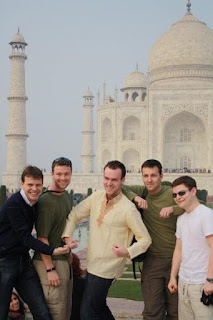 I think we were meant to look tough in this picture
Reporting from Agra
Another early morning today as we headed out on our five-hour bus ride to the ancient Mogul capital of Agra. Fortunately, we decided to stay the night there, instead of making it a day trip. Regardless, we’ve been racking up our bus time… The bus ride gave us another opportunity to shop at an opportunistic tourist shop along the highway, so that’s good.
A note about driving in India. First, there are no freeways and the traffic along the highways generally crawls along at about 70kph. You do get to see a number of exciting sights though: monkeys, elephants, camels, herds of sheep, temples, etc. Commercial vehicles are generally only licensed to operate in one state, so at every border we had to stop to purchase a license allowing the bus to continue. I would have guessed that this would impede interstate commerce, but it doesn’t seem to be too significant. Almost all the trucks have “Blow Horn” or the like written on their tailgates and the other motorists comply gladly.
How was the Taj Mahal?
-Spectacular
Did you take lots of pictures?
-Yes
(Pictures are worth a thousand words)
 Obligatory Taj solo picture
Apparently, the Taj makes people jump for joy! (Sorry Carlyn...)
 I think we were meant to look tough in this picture
Sunday, January 11, 2009
Homework
I'm going to be another day or so before I post again. I'm finishing up my last final. Been having fun though and have a lot of great pictures!
Saturday, January 10, 2009
Travel Day (and Shawarma)
Reporting from Delhi
Not a lot going on today - I spent the morning in my room finishing my Economics and Security final (Got it in 2 hours before the deadline!) while most everyone else did a short tour of Bangalore. Apparently I didn't miss much, which is what I expected based on the travel guides. Our flight to Delhi was uneventful, but I would like to note that the Indian airlines still serve food in their economy class and have great service despite cheap tickets. Take that United!
Once settled in Delhi, we decided to celebrate our halfway point by throwing caution to the wind and eating at what was basically a street vendor. The food was amazing and the staff found our presence quite amusing, it seems that few foreigners have the guts (literally and figuratively) to eat there. We raised a few eyebrows by ordering too much, but we did our damnedest to eat it all. We were almost successful... I had a pile of bones on my plate testifying to the carnage. (unfortunately I didn't have my camera so I'll have to wait for the picture swap to review.)
Tomorrow, it's an early morning drive to Agra where we'll see the Taj Mahal, to knock another Wonder off my list!
Not a lot going on today - I spent the morning in my room finishing my Economics and Security final (Got it in 2 hours before the deadline!) while most everyone else did a short tour of Bangalore. Apparently I didn't miss much, which is what I expected based on the travel guides. Our flight to Delhi was uneventful, but I would like to note that the Indian airlines still serve food in their economy class and have great service despite cheap tickets. Take that United!
Once settled in Delhi, we decided to celebrate our halfway point by throwing caution to the wind and eating at what was basically a street vendor. The food was amazing and the staff found our presence quite amusing, it seems that few foreigners have the guts (literally and figuratively) to eat there. We raised a few eyebrows by ordering too much, but we did our damnedest to eat it all. We were almost successful... I had a pile of bones on my plate testifying to the carnage. (unfortunately I didn't have my camera so I'll have to wait for the picture swap to review.)
Tomorrow, it's an early morning drive to Agra where we'll see the Taj Mahal, to knock another Wonder off my list!
Friday, January 9, 2009
Math Festival!
Reporting from Bangalore...
Today has been the highlight of the trip so far. We visited the Rishi Valley Institute, an organization that is improving the way primary education is delivered to rural communities. To get there, we had to drive 4 hours south of Bangalore, but it was worth it. The bus ride was “interesting” to say the least with a more than a few zero gravity moments. I guess that’s what happens when you combine bad back country roads with bad bus suspension.
Despite the horrific journey, there weren’t any accidents or overly nauseated passengers, so once we arrived we were excited and rearing to go (albeit a little shaken.) Two Indian educators who believed the traditional education system had structural and cultural barriers that inhibited rural traditions from receiving an education started the Rishi Valley Institute in the early Eighties. The program focuses on a self-paced, moderated program with simple activities to promote self-learning. It also incorporates cultural elements by bringing in family and community members into the school and eliminates textbooks. This is especially important in India, where a textbook that comes from only a few hundred miles away may be written by a non-native language speaker who is completely segregated from the cultural norms of the area.
After getting a short introduction, we visited a math competition that invites the community to try their hand at events moderated by the students. We each received scorecards and were to go visit the various stations. They ranged from guessing ones height or weight to playing with tannengrams. Most of the kids had a rudimentary knowledge of English and we also had a few helpers to assist (they wore sashes that said, “May I help you?”). Our welcome was amazing and the group was extremely friendly.
After the fair, we went to visit another school site to see the system in action. The students there were enthusiastic, if shy at first, for our visit. Without speaking a common language we still managed to have a few laughs as they tried to teach us to "read" their composition books. It turns out that I learned how to say "I want to learn", appropriate for the setting. Afterwards, they did a small puppet show for us, demonstrating an important aspect of incorporating culture into the lessons.

India Trekkers with the Rishi Valley founders
A couple of excited kids at the Math Competition

Reading aloud (I didn't take this picture, I gave my camera to one of the students. Pretty good job!)
 My grades after the math camp... a couple of Bs, not bad! (Considering everything was in metric measurements and another language)
Subscribe to:
Posts (Atom)